About the Article
 The Algonquin Bag Rats have many other stories to relate of the days gone by. Perhaps we'll have others to share with Fairways & Greens readers in future issues
 Fairways & Greens has documented St. Louis golf history for decades, and few pieces in its archive capture the texture of the game’s past quite like this one. Larry Etzkorn — longtime Secretary of the St. Louis District Golf Association and Director of the Missouri Golf Association — sat down with St. Louis golf historian Jim Healey to recall his days as a caddy at Algonquin Golf Club in the early 1940s. Healey, who has authored nearly a dozen books chronicling the history of St. Louis-area country clubs and is currently writing the Gateway PGA Section’s 50th anniversary history, has spent decades preserving stories like this one.
Along the way, Etzkorn crossed paths with two Gateway PGA Hall of Fame members whose names still resonate in St. Louis golf history. Dick Shaiper, then an assistant pro at Algonquin, would go on to serve at Norwood Hills Country Club, Missouri Bluffs Golf Club and The Links of Dardenne before spending more than four years as Executive Director of the Gateway PGA Section. Dutch Harrison — known throughout the game as “The Arkansas Traveler” — was one of the most celebrated players of his era, a three-time Ryder Cup team member who won 18 PGA events and was inducted into the PGA of America Hall of Fame in 1962. Harrison spent the better part of two decades calling St. Louis home, serving as the club professional at Old Warson Country Club and later Forest Hills Country Club.
Originally published in the August 7, 1998, edition of Fairways & Greens, we’re sharing it this week in honor of our member tournament at Algonquin — a course that, as you’ll read, has been shaping golfers and golf careers in this region for a very long time.
Algonquin Bag Rats
by Larry Etzkorn as told to Jim Healey“Skinhead” Etzkorn and “Red Ryder” Reilley were doing what 13-year-olds have done through time; enjoying the first few days of their summer vacation while trying to figure out how to earn some money. In 1941, their choices were a bit limited. They could mow lawns, but those push mowers were hardly user-friendly. Suddenly Reilley bounced up. “Let’s go over to Algonquin Saturday and see if we can caddy.” It was a brilliant idea. They could earn 35 cents an hour toting a bag for — what they thought — some “old hacker,” giving them a tidy sum that would get them into the movies and let them buy some popcorn as well. There didn’t appear to be a down side to his idea.
We spent some of our future earnings as we hopped the Manchester streetcar, which ran from Kirkwood to Berry Road, where it continued down Lockwood into Webster. We walked the two blocks to Algonquin to begin our work. As we approached the sagging stockade fence which surrounded the yard, we both began to feel a bit timid. We could feel the heat from the black cinder floor through our “tennies,” which only added to our nervousness.
Besides a gathering place for caddies, the aging shed housed members’ clubs and held the balls, tees and other merchandise that the club pros hoped to sell to members. The Harrison brothers, Don, Elmer and Walter, shared the Pro duties at the club. Well, “shared” might be a bit inaccurate. While Don did most of the golf instruction, Elmer was charged with keeping the caddies in line, a job he did with much fervor. Always with a pocket-full of change, Elmer would pace the floor, keeping court over the caddies, ever watchful of approaching members. It was Walter, however, who most of the members dealt with on a daily basis. He ran “book” out of the caddy-house, hanging on the phone continuously as he placed bets at area race tracks for the “respectable members.”
We took our place in line with the others, hoping to hear our name called to draw a bag. As I looked around, I was struck by the bizarre collection of hopefuls. There was “Lightening” Pete Madey, “Drivin’ Tee” Donavan, and “Wino” Sullivan. These were course veterans who would carry double, sometimes twice a day. After collecting their fee, they would make the trip to Liggetts Drug Store in Webster, (where they would select one of their finest bottles of “the grape”), and head over to the Train Shelter off Lockwood (where they would discuss the day’s events while sipping their favorite beverage). They would remain there through the night as they slept off the effects. No one dared challenge them.
The other group consisted of grade school and high school-aged boys, many like “Red” and I, looking to pick up a few dimes. There was “Chink” Jordan, Jim Jordan, Wayne Sullivant, Glen Hirt, “Fat” Art Hutsell, Jack Heath, “Eggy” Higgins, “Crow-nose” Keller, “Tattoo” Keller, “Memphis” Keller, D. Plaake, J. Garrison, Neal Hedges, Don “Loops” Mester, “Iron eyes” McDonnell, “Red” Heath, and finally Bill, Bob and Johnny Villhard. Most attended Webster Groves High School, so even though we knew of them, we were Kirkwood outsiders.
Reilley and I sat watching the events, trying to get the pattern. Waiting for a bag, many of the regulars sat around a couple of crude wood tables, playing a game called “Knucks.” This harmless-sounding game could leave the loser with blood all over his hands. Counting the number of points in your hand, the one with the highest total was at the mercy of the winner, as he would slap the deck over your knuckles that number of times. You either got good or your knuckles got raw.
Mostly we just sat, drinking our dime bottles of soda, trying to pass the time. Elmer had rules for everything you did, and breaking them put money into his pocket; accounting for the ever-present rattle as he walked the room. Breaking a bottle would bring an immediate roar of “nickel,” which was the associated fine, and Elmer would head toward the offender to collect his due. You got to clean up the mess and pay for it.
The regulars were always coming up with new ways to pass the time and initiate the newcomers. If you fell asleep, you could count on getting a hotfoot as punishment. If matches weren’t available, they would fill an empty soda bottle with water and tie it to your belt loop. Then, they’d call your name, making you think you had a bag. As you jumped toward the door, you could break several bottles enroute, much to Elmer’s delight. Another popular trick was to stuff paper into soda case empties and set them on fire. There was never a dull moment.
When Elmer wasn’t around, caddymaster Mick McChord held court. He was a tall, tobacco-chewing, loud, surly individual who was known to imbibe on occasion. It fell upon him to teach us how to caddy. Ever fearful of comments from angry members about an insolent or inept caddy, he told us to be polite and keep our mouths shut — lessons that we quickly learned.
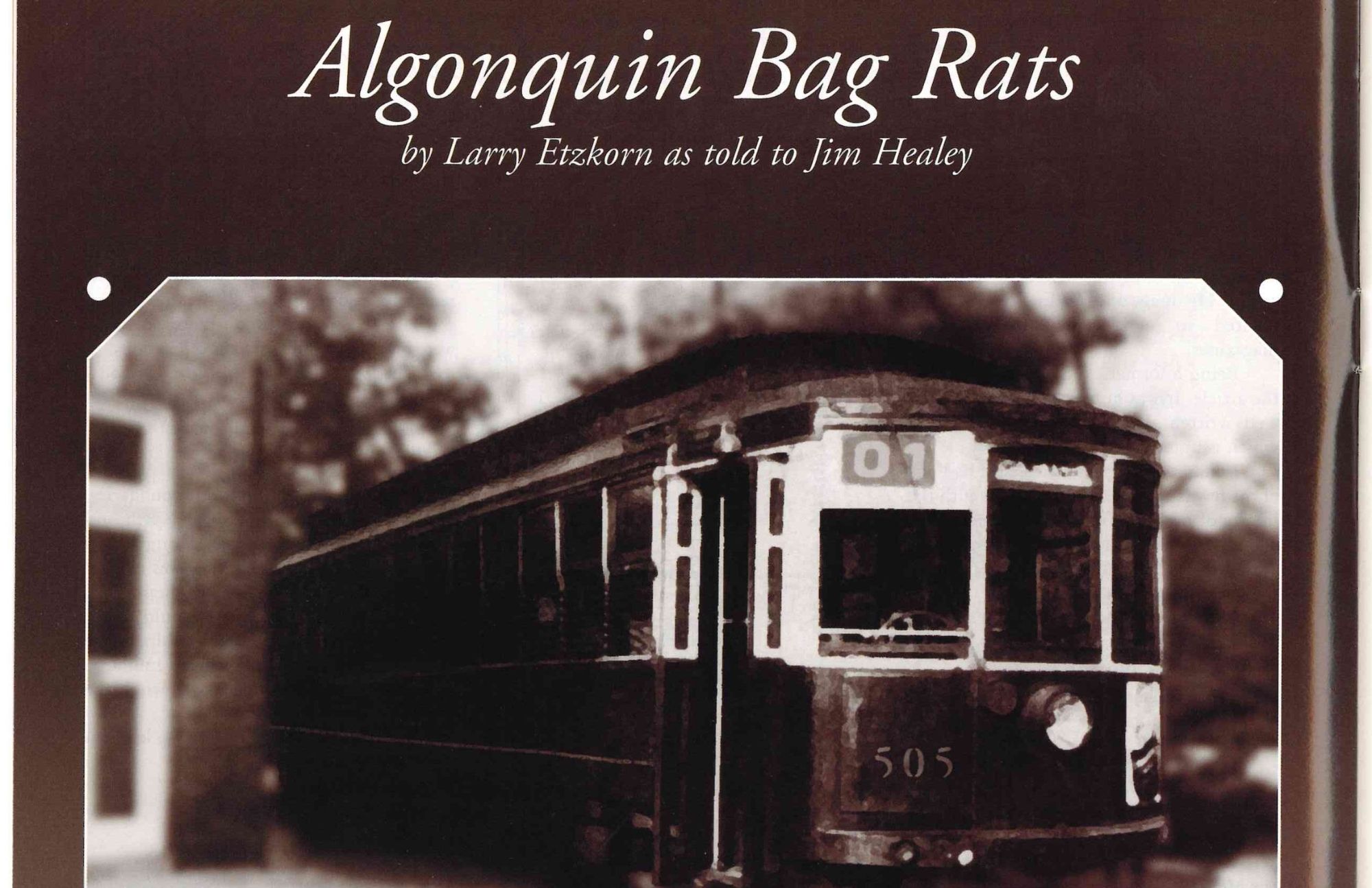
Our first Saturday on the job, Red and I sat there all day and never drew a bag. Most of the other caddies were more fortunate. For your efforts, you usually collected $1.25 per bag, including tip — that is, unless you looped for Sam Greenland. Mr. Greenland owned the “01” streetcar line which ran from Kirkwood to University City, cutting through the course, and separating holes 11-13 from the rest of the club. He would give his caddy $1.05 and two tokens for his efforts.
My first loop came two weeks later, a quick 9 holes for which I made 75 cents. It wasn’t much, but it was a beginning. As time marched on, I got a regular named R.C. Geekie, a prematurely gray member who played off a 2 or 3 handicap. He paid well. After his usual front-9, Mr. Geekie always stopped to get what he called a little “hair oil.” Whatever “hair oil” was, he almost always scored better on the incoming nine after getting it.
The next season, Red and I were veterans and, as a result, almost always drew a bag. This was the first summer during World War II. The war brought a shortage of materials, and golf balls were among those which were a precious commodity. If your bag hit an errant shot, you had better find it or they would look for another caddy next time. One late autumn afternoon, we had reached the tenth hole, a dogleg left over water, where a large amount of leaves had accumulated on the left side in a swale. Mr. Geekie hooked one of his valued Spalding Dots right into the swale. After an exhaustive search to no avail, R.C. was so upset, he lit the leaves on fire so no one else would get his ball. We heard the sirens from the approaching fire-truck when we were on the 11th green. I don’t think they ever found out how that fire got started.
His usual group on Saturday and Sunday was H.D. McGowan, Zud Schamel and W.W. Lewis. Frank Feller, Jr. Kirkwood was in the group. He usually had Frank Feller, the best caddy at Algonquin, carrying for him. J.R. had one dream in life — to win the Algonquin Club Championship. In search of this quest, he would pay to have Masters Champ, Henry Picard, come to St. Louis from his club, Canterbury CC in Cleveland. Picard came every Friday during the summer to give J.R. a 9-hole playing lesson, and his efforts — and pocketbook — finally paid off, as J.R. won the championship.
Surprisingly, caddies at Algonquin were not allowed to play the course. Oh, we would sneak an occasional shot now and then, but we couldn’t play the course. A few years later, the caddies lobbied to be allowed to play on Mondays. Led by Glen Hirt, it took awhile, but the club finally relented and we were allowed to play. Oscar Bowman, the green superintendent who resided in the house by the 2nd tree, was not a fan of this policy. He marched into the caddy-house and informed us that the first player who failed to repair a divot or ball mark, or failed to rake a bunker, would be tied to a stake and burned. Well — at least they would be expelled from the course. The first Monday, Jerry “Tattoo” Keller and I were among the group who played. “Tattoo” was in the bunker at the first green and he bladed his shot over the green. In disgust, and after a few descriptive phrases, he leaped out of the trap, forgetting to rake. We had just hit our tee shots on #2 when Mr. Bowman, lurking nearby, saw our transgression and leapt at the opening. He marched toward our group, and with a twinkle in his eye, threw all of us off the course. We were banished. With our bags over our shoulders, we headed toward Berry Road, discussing our options. We only had one option — we caught the first streetcar and headed toward Crystal Lake GC to continue our play. A short time later, much to Mr. Bowman’s dismay, we were all reinstated.
During my last year of caddying, 1947, a few events stand out as the most interesting and humorous. One Sunday, “Drivin’ Tee” Donavan and I were carrying doubles for a foursome. I had Mr. and Mrs. Ted Sharp and “Drivin’ Tee” had Mr. and Mrs. Hoopes. “Drivin’ Tee” was hung-over and a bit surly, so I did my best to avoid him. The 12th is a dogleg left and you can’t see the fairway from the tee due to trees and the terrain. We were just off the fairway with the bags, acting as forecaddies, waiting for the tee shots. Mr. Hoopes yelled to us to see if the fairway was clear and they could hit. “Drivin’ Tee” seized the opening. He told me, “Just as soon as I hit, tell them it’s clear.” With that, he laid down three brand new balls out of Mr. Hoopes bag, and fired them at the greenhouse across the road, paralleling #12. He just wanted to see if he could break some of the glass. Somehow, Mr. Hoopes spotted him. Furious, Mr. Hoopes yelled at “Drivin’ Tee,” firing him on the spot. Donavan dropped both bags, and walked over by the 11th green where he caught the “01” streetcar.
The second event involved Mr. Donald Bisanct at the 10th hole. Mr. Bisanct was having a great deal of difficulty hitting across the lake. Late one Saturday, he called for his clubs and a caddy, who unluckily turned out to be “iron eyes” McDonnell. “Oh, s——,” was McDonnells comment, painfully aware of the fate about to befall him. Bisanct laid up to the lake and proceeded to submerge every ball in his bag, trying to reach the green. His anger grew until he looked like a thermometer. With no balls left, he threw every club in his bag into the lake and followed with the golf bag. With nothing left to throw, but with his anger un-restrained, the only thing left was “iron eyes.” Bisanct began to chase him around the lake and up the 10th fairway to Berry Road where “iron eyes” escaped by the skin of his teeth.
Dick Shaiper, then an assistant pro at Algonquin, related another story. It seems that one very hot, muggy day, one of the old-time caddies was toting two bags when he reached the front of the 2nd green. Suddenly, he fell face down on the fringe with both bags landing on top of him. To all present, he appeared to have died. The member rushed to the pro shop and told Dick that “Red the wino” was down and wasn’t moving. Dick went into the grill and found a doctor to examine him. When they reached the green, the doctor found no heartbeat and pronounced him dead. They covered him with a large towel, stripped the two golf bags from his shoulders and called an ambulance. When the ambulance arrived, the attendants went to the green, but Red was gone. He apparently had had a heat stroke. After a few minutes under the towel, however, he cooled off, woke up, and took off.
Perhaps the crown jewel for any caddy is to loop in a pro event. To caddy for a top player makes it even better. At the 1947 US Open at St. Louis CC, the best caddies from each area club were selected to caddy. The tobacco-chewing Mick McChord drew Ben Hogan, one of the pre-tournament favorites. On the 18th fairway on Friday, Mick, having an enormous hangover, went down from the heat. Mr. Hogan finished the hole, and later came out to practice. I was hanging around after carrying for some croquet-putting amateur who failed to make the cut. When Hogan asked for someone to shag for him, I willingly volunteered. It was an experience in perfection. The Polo Field was used as the range, and Mr. Hogan told me to go out in the field and pick up the balls. He would begin with his 5-iron and work his way through his bag, ending with the driver. One shot after another soared toward me, and I never had to move out of my tracks until he got to his 3-wood, and then it was only one step in either direction.
We marched to the first tee, and proceeded to play the 1st and 2nd. When we came to the 2nd, Mr. Hogan said to throw all the practice balls into the bunker on the left. The 2nd is a famous par-3 with a 120-foot green and a large swale in the middle. Hogan knew how he wanted to play the hole. In the event he missed the green, he intended to fill the bunker. He proceeded to fill the cup with bunker shots until they covered the green around the hole. Hogan began to examine the green carefully. In those days, the greens were cut with the grass laid in one direction. Mr. Hogan told me that if he could put the ball in a position on every green to putt with the grain, he would win the Open. That is how precise he was.
Later that day, Joe Kirkwood Sr., the famous trick-shot artist, put on a display in the “Grand Canyon” bunker in front of the 18th green at the Country Club. He stood in the bunker and faced back toward the tee. He swung and the ball came out backwards and landed onto the green. A spectator challenged him to do that again, and he did. Then, since seeing is not always believing, he placed three balls side-by-side and hit them simultaneously with the first ball slicing, the middle ball straight, and the third ball hooking; with all balls crossing in midair at one point. Next he stacked three balls, hit the bottom ball high in the air, the middle ball low on the ground, and caught the top ball in his hip pocket. The crowd was astounded.
The next day, the last two rounds of the Open, I carried 36 holes for the incomparable Dutch Harrison. In the morning round, Dutch made 2 at the 2nd and went on to shoot 69 and moved up the ladder. After lunch, the final round began and we were in contention. We parred the 1st, and at the 2nd, Dutch asked me what club to hit. Now Dutch had birdied the hole in the morning round, so this surprised me. I believed the air was lighter, so I simply put a finger under the head of the one iron, but Dutch shook it off, grabbed the 4-wood and fired it over the green. We made a quick 6. He was livid. Then lightening struck his game and he ran off birdies on #3, #4, #5 and #6 to go 1-under. We were on a roll. At the 7th, a great par-3 with a roller coaster green, he again asked me what club to hit. I fingered the 7-iron and again Dutch shook it off and fired a 6-iron over the green into the back wall of the deep bunker. Surveying his options, he realized he had no shot toward the hole so he hit the ball to a level lie in the bunker, blasted out, and made a 5. We parred the 8th and birdied #9 to par the front 9. Five birdies, a triple bogey and a double bogey made for a unique front nine. We parred the back nine, and Dutch would finish in a tie for 13th, as Lew Worsham beat Snead in their playoff. Dutch may not have been able to conquer St. Louis that week, but his up and down round proved one thing; there was only one Dutch.
The Algonquin Bag Rats have many other stories to relate of the days gone by. Perhaps we’ll have others to share with Fairways & Greens readers in future issues